





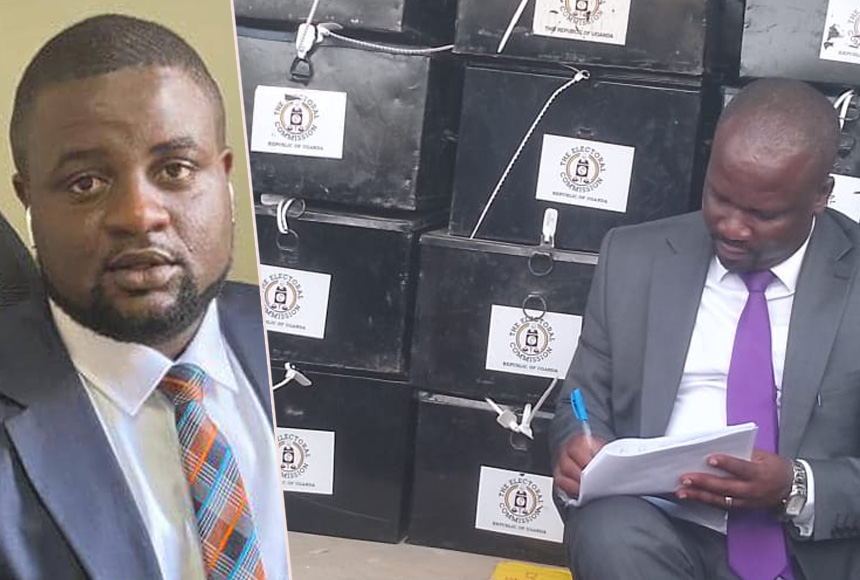
A Kampala lawyer has asked the government and the Electoral Commission to amend the Parliamentary Elections Act to provide for a substantive law on what amounts to tampering with election material in the process of vote recount.
Currently, the courts rely on a law made by a judge to define what amounts to tampering with election material to determine applications seeking for recount because the Parliamentary Elections Act is silent.
Brian Kupper Rubihayo, a senior advocate with Mwesigwa Rukutana Advocates explained that the existing law made by Parliament gives the Magistrate’s courts powers to recount but does not elaborate what court should do in certain circumstances.
“The matter of what amounts to tampering should be discussed by Parliament such that there is a substantive law guiding the courts on how to deal with it. I understand that the biggest beneficiaries of this law are Members of Parliament and they might legislate so strictly against vote recount but I implore the government to also look at the laws as passed by the judge-made laws (decisions of court) on tampering and recounting in general such that some of them are codified,” Rubihayo said.
More Read

According him, in 2001, court while deciding the case of Winnie Byanyima and Ngoma Ngime gave its guidance and the law that where you find the box tampered with, the recount should be stopped.
Rubihayo made the remarks in response to the decision made by the Magistrates Court in Hoima where a Chief Magistrate stopped a vote recount basing on repetition of serial numbers in the booklet.
He was the lead lawyer representing former female youth Member of Parliament Diana Ampeire who sued her rival Mercy Kanyesigye, Electoral Commission and the Returning Officer who declared the winner of the female youth representative in Parliament.
Court records show that Kanyesigye was declared winner with a margin of 18 votes in an election conducted by way of Electoral College leaving Ampeire dissatisfied that is why she applied for a vote recount in the Magistrates Court.
Ampeire argued that during the vote counting, her votes were falsely attributed to Kanyesigye reasoning that by a recount, Ampeire would have more votes than her political rival.
However, Rubihayo said that court basing on the inconsistencies which were as a result of printing, stopped he recount even after counting the number of ballot papers in the box finding out that the same number of votes cast were declared on the declaration form.
Rubihayo said that the court allowed the recount but they were surprised with the definition of tampering as laid down by the magistrate; “and our position is that it was beyond. It is not tampering or verifying whether there was tampering but it was actually auditing of the electoral process conducted.”
“Our argument is that the law as it stands on recount does not call for an audit to see if the ballot papers were printed properly or not. If court finds that the seals are intact and they have not been altered or changed or damaged, then they should do a recount but we feel that the decision of the magistrate in that particular recount in defining tampering went into auditing,” he added.
Rubihayo reasoned that it was wrong for the magistrate to base on duplicated serial numbers to stop a recount because it is not a requirement and the forms do not give a provision where to indicate the serial numbers of the seals to be used.
“What the magistrate did was not to verify whether there was tampering but what he did was an audit whether the election was properly handled which matters are either for the petition or which matters have no legal remedy because no court in Uganda has the power to audit the Electoral Commission,” he stressed.
Rubihayo suggested that the courts must be alive to the fact that if they restrict tampering to any breaking of the seal, then what the other opponent needs is just to get away of cutting that seal even without doing anything and circumvent the process.
“So if the courts insist on taking tampering in that strict application, then the whole process of recount would be rendered toothless and nugatory,” he said.