





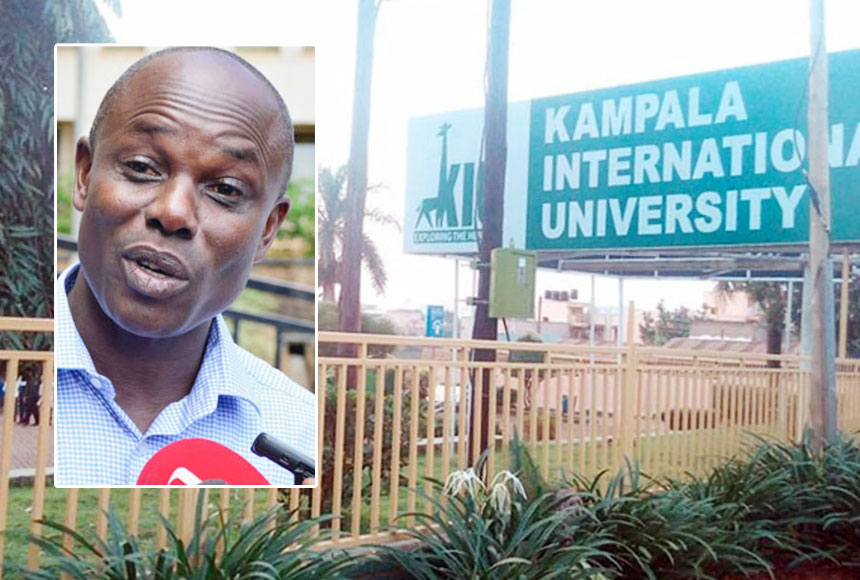
Controversial businessman Hassan Basajjabalaba together with his lawyers led by Joseph Kyazze are camping at the Court of Appeal which also doubles as the Constitutional Court to plead with the Registrar to speed up the processes of allocating their file to a Court of Appeal Judge to stop the execution of the orders issued against him by Justice Stephen Mubiru the then judge of the Commercial Division of the High Court.
Kyazze pleaded with the registrar to speed up the process explaining that his client’s multibillion empire is under threat because the bank which wants to execute the court orders has already written to him informing him that the process of auctioning his university has started and it is likely to be done by the end of this month.
Kyazze stated that if possible, the application he filed against Housing Finance Company Limited of Kenya be fixed to be heard and determined immediately after the Easter holidays otherwise his client is likely to lose his multibillion empire including Kampala International University (KIU).
Basajjabalaba instructed his lawyers to rush to Court of Appeal after Justice Mubiru declined to stay the process of execution against him explaining that he failed show that the execution will affect the merits of the grounds and arguments raised on appeal.
More Read

The Judge also ruled that Basajjabalaba did not also demonstrate a reasonable basis to support the belief that there is a real prospect that it will not be possible for the Court of Appeal by its orders to recover his money which was taken by the bank after they won at the Court of Appeal.
“The Court has not lost sight of the fact that the applicant is a private university. Although the decretal sum is a significant amount and there is no doubt it has the potential of affecting the normal operations of the applicant if drawn at a go, I am not satisfied that it’s recovery will cripple the applicant’s ability to pursue its appeal, thereby paralysing the exercise of its right of appeal,” the judge stated.
Justice Mubiru cited that arbitral proceedings revealed that the university stopped servicing the loan sometime in 2016 adding that there is no evidence to show that for the five years since the award was handed down, the university has made any effort to repay the sum of money it borrowed yet it does not deny having borrowed from the principal sum.
He explained that if an order of stay is granted, it is likely to inflict greater hardship as it would disproportionately harm the respondent who would, as a result, be unfairly deprived of its right to benefit from the fruits of an Arbitral Award delivered in its favour.
However, counsel Kyazze pleaded with the appellant court that if the order of execution is not stayed, it will render his appeal useless.
According to court records, in 2010, KIU commenced a project to expand existing facilities and construct new ones, including lecture rooms, administration blocks, hostels, dining facilities, library and staff accommodation at its campus in Kajiado in Kenya.
The university borrowed USD15m from the Housing Finance Company of Kenya to partly finance the project.
However, Housing Finance could only afford to facilitate the project with USD10m.
The bank persuaded the university to revise the scope of works to fit within the available USD10m and the university agreed to mortgage its 62-acre land on which the university sits. The loan was supposed to be paid within 15 years.
However, the two parties later developed a misunderstanding over the amount of money to be paid in interest and concerning how much the financing company had given to the university. By that time, the bank had already given the university USD11.3m.
The parties agreed to go for arbitration in Kenya to resolve their misunderstanding and a single arbitrator discovered that the university had been overcharged in interest, and that the bank had outstanding money that had not been paid amounting to USD11.3m already disbursed. The loan amounted to USD13,817,270.87m which also continued to attract interest and other associated charges.
The tribunal subtracted USD1.049m that had been overcharged and then ordered the university to pay the bank USD12,767,508.33m a decision which the university objected to and decided to file a suit first in a Kenyan court and eventually in the Commercial Division of the High Court.