
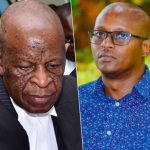


Controversial city businessman Haruna Ssentongo’s multimillion empire is on the verge of collapsing after three justices of the Court of Appeal led by Justice Cheborion Barishaki, Christopher Gashirabake and Dr Asa Mugenyi allowed I&M Bank to auction his properties and recover their money which he secured through a loan and failed to pay back as agreed.
In their judgement, the justices dismissed with costs the appeal filed by the businessman challenging the decision and orders made against him by Justice Justice Richard Wejuli Wabwire of the Commercial Division of the High Court claiming that he erred in facts and law when determining the said matter.
In his appeal through his lawyers led by Derrick Bazzekuketta, Ssentongo accused the bank of breaching the terms of contract they signed.
He further accused the bank of breaching the fiduciary and statutory duties as stated in their agreement which resulted in misrepresentation and negligence, undue influence, economic duress, unfair and unconscionable terms of contract, unjust enrichment from extortionate interest terms and charges.
More Read
He confirmed to Court in his affidavit that in 2015, he entered into a loan transaction with the bank and obtained credit facilities to finance the development and completion of his commercial property on land comprised in Kibuga Block 12 Plot 825, known as Nakayiza Mall, and to finance working capital for his imported garments in his trading business.
He added that between November 2015 and January 2016, he sought additional financing from the same bank amounting to US$ 3,000,OOO/ for the purpose of financing the completion of another property on land comprising Kibuga Block 12 Plots 250 & 251 known as Segawa Market.
He added that on the request of the bank, he presented bills of quantities for the construction of Segawa Market which was to be developed with 250 shops, and was estimated to generate a minimum of Shs500m in rental income per month.
However, in their judgement, the justices explained that there was no such evidence to support Ssentongo’s allegation showing that he entered a deal with the bank as he claimed while lawyers of the other side rubbished the allegation.
In their defence, the bank through their lawyers led by Bruce Musinguzi of the famous Kampala Associated Advocates (KAA) told court that whatever was agreed upon between the bank and the appellant was put on record and both parties signed.
They added that Ssentongo applied for several loans and received the amount of money on different dates on different terms and conditions.
The lawyers explained with evidence that Ssentongo first received a loan of Shs1.8bn and an overdraft facility of Shs150m as security for the advanced facilities.
They added that Ssentongo mortgaged his property comprised in Kibuga Block 12 Plot 825 at Mengo Kampala city and the said loans were disbursed to him through a bank account he owned with their client and that the granted facilities were conditional on him domiciling 50% of the rental income from the mortgaged property. They also agreed that the agreement will attract interest and penalties in case he defaults.
On 23rd September, 2015, he also applied for another loan of Shs2bn which was granted to him after presenting the same property comprised in Kibuga Block 12 Plot 825 at Mengo as security and by the time of its disbursement, he had an outstanding loan amounting to Shs1,773,959,584 and an overdraft facility standing at Shs15O,O0O,OOO which continued to accrue interest and penalties in case of default.
On 3rd December 2015, Ssentongo was also granted a loan facility worth Shs500m and an overdraft worth Shs450m using the same property as security.
On 18th November, 2015, he applied for another loan of USD. 3,00O,00OO00 and this time he explained that the loan he applied for would be used partly to offset his outstanding facilities and also finance construction of a new commercial property on Kibuga Block 12 Plots 25O and 251 and on 22nd February 2016, he was given another loan amounting to Shs5bn
The lawyers explained that subsequently, upon failing to meet his outstanding loan repayment obligations, Ssentongo through a letter dated 3rd August 2016 requested the bank to consider consolidating his existing loans into one term loan with a single monthly instalment arborized for a period of five years.
The bank on 13th September 2016, rejected the application after he failed to comply with the advised conditions.
On 30th September 2016 he made a second request for consolidation and amortization of his outstanding loans which was accepted.
In support of his request, he had represented to the bank that he would domicile all trading proceeds and at least 8O% of his rental proceeds through his account held with the bank and also pledged to maintain an average monthly credit turnover of Shs500m an application that was granted by the bank.
They noted that on 12th October 2016, Ssentongo acknowledged that his debt position on all his existing facilities was Shs9,695,502,000 and the bank contended that despite the amalgamation and the various undertakings by him, he continued to default on his monthly repayment obligations which resulted into issuing of a notice of default dated 22nd December, 2016.
He continued failing to service his loan which resulted into issuing of a notice of sale of his mortgaged property comprised in Kibuga Block 12 Plots 251 and 825 at Mengo.
In an effort to settle the outstanding debt obligations, he executed an agreement of sale of the property with Downtown Bags Ltd and sold the said property at USD.8OO,OO0.
However, by an addendum served to the bank, the purchase price of the property was valued to be USD.7OO,0OO and Ssentongo had acknowledged receipt of USD 600,000 and out of the USD 600,000, the bank only received USD 326,627 which was paid towards the clearance of part of his outstanding arrears.
The lawyers contended that when they started the process of recovering their money, Ssentongo petitioned the Commercial Division of the High Court accusing the bank of redacting his money from his bank account without his permission.
The bank also filed a cross petition in the same court seeking for the recovery of Shs10,384,396,959 and the matter was determined in the bank’s favour.
However, Ssentongo appealed and secured a court order stopping the bank from executing all the orders issued by the lower court until the determination of the appeal in the Court of Appeal.
However, Justice Barishaki who wrote the lead judgement agreed with Justice Wabwire and dismissed Ssentongo’s appeal with orders that bank should recover its money amounting to a tune of Shs10,384 ,396,9591 with interest of 12.5o/o from 22nd January 2019 until payment in full is made.
The bank further awarded general damages of Shs150m with interest of 60% from the date of the judgement until payment is done in full.
This website has established that Ssentongo is in deep financial crisis and his financial empire is under threat from being attacked by financial institutions and money lenders.
His efforts to save his properties have been frustrated because banks and money lenders no longer want to give him financial assistance in terms of loans with fear that he might turn against them as he did to I&M bank.
However, sources close to him have intimated to this website that Ssentongo has already instructed his lawyers to challenge Justice Barishaki’s decision in the Supreme Court and a notice of appeal has been filed.